Nov 3, 2026 · Knowledge & Guides
NPT vs BSP Threads: A Practical Guide for Pipe Nipple Buyers
How NPT, BSPP and BSPT threads differ in angle, taper and sealing, what happens when they are mixed on site, and the exact wording that keeps a pipe nipple purchase order unambiguous.
The most expensive thread problem is not a manufacturing defect. It is a 1/2 in. nipple that turns two revolutions into a valve port and stops, or a fitting that screws in and weeps at the first pressure test. Both parts are within tolerance; both are simply the wrong thread. The cost is rarely the price of the nipple; it is the labor, the cut-out and the schedule.
We have made carbon steel and stainless steel pipe nipples and fittings in Qingdao since 2003, largely for buyers in Europe and North America. This guide covers the practical differences between the two families, the failure modes when they are mixed, and the wording that keeps a purchase order unambiguous.
Two Thread Families
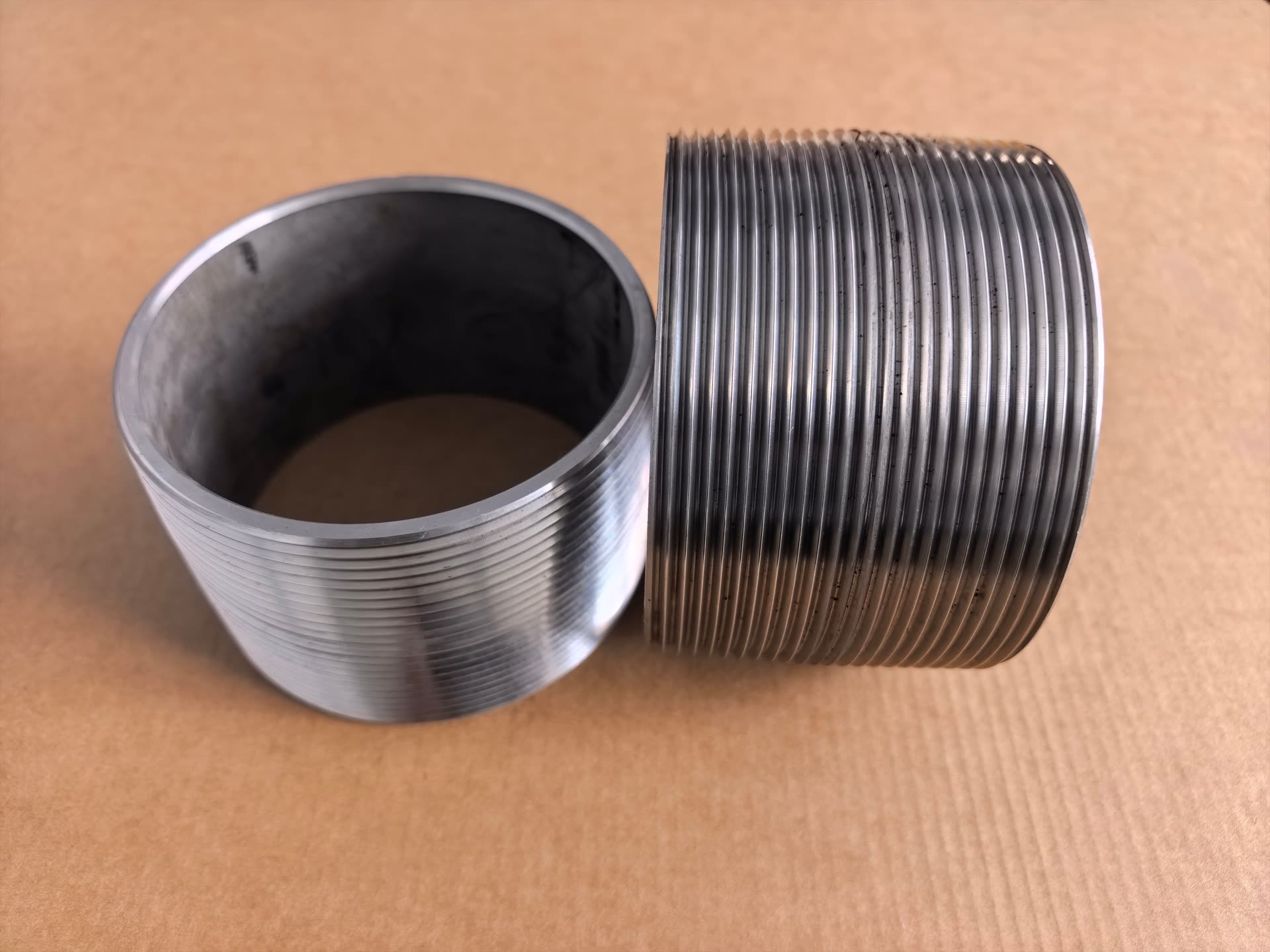
Almost every threaded nipple and fitting we produce is cut to NPT, the American family, or BSP, the British family still used across Europe, the Middle East and much of Asia. They are not interchangeable, and no amount of sealant turns one into the other.
NPT is defined by ASME B1.20.1. The thread form is 60 degrees with a taper of 1 in 16, and the taper does the sealing: as the male thread advances, the flanks interfere along the helix, and with a compatible sealant the joint closes. It is the default for building water supply and drainage, industrial piping and fluid transfer in North America.
BSP splits into two forms that behave differently. BSPP, often written G, is parallel, defined by ISO 228-1, with a 55 degree thread angle and constant diameter. It does not seal on the thread; a bonded washer, an O-ring or a machined face closes the joint, which is why BSPP is common on instrumentation and equipment ports. BSPT, often written R, is tapered like NPT, also at 55 degrees, and is defined by ISO 7-1; it seals on the thread with a sealant. A drawing that says only "BSP" hides this distinction, and that is where most ordering errors begin.
At a Glance
The table below summarizes what a buyer checks. Thread and product standards are separate callouts: a welded nipple may be ordered to ASTM A733 and a malleable iron fitting to ASME B16.3, but the thread line still must name NPT, BSPP or BSPT.
| Feature | NPT | BSPP (G) | BSPT (R) |
|---|---|---|---|
| Thread angle | 60 degrees | 55 degrees | 55 degrees |
| Taper | Tapered, 1 in 16 | Parallel | Tapered, 1 in 16 |
| Sealing method | Thread sealant or PTFE tape | Washer, O-ring or face seal | Thread sealant or PTFE tape |
| Reference standard | ASME B1.20.1 | ISO 228-1 | ISO 7-1 |
| Common markets | North America | Europe, Middle East, Asia | Europe, Middle East, Asia |
A 1/2 in. NPT and a 1/2 in. BSP both carry 14 threads per inch, so they cannot be separated by eye or by a pitch gauge alone; the flank angle and pitch diameter differ. And nominal size refers to the pipe bore, not to any thread dimension, so "1/2 in." alone says nothing about the thread.

Mixing Them Up Is Expensive
An NPT male forced into a BSPP female is the most common mismatch. The 60 degree flank meets a 55 degree flank at an angle, so contact collapses to a line instead of a full flank. The thread binds after one or two turns, and continuing with a wrench deforms both parts. A joint forced home holds by luck rather than interference, and will not survive pressure or thermal cycling.
The reverse, a BSPP male into an NPT female, engages only the first few threads before the parallel section bottoms in the taper. It can feel tight and still leak at low pressure.
The most deceptive combination is BSPT into NPT. Both are tapered, so the fitting screws in several turns and looks seated. Because the flank angles differ, contact is partial, and the joint can pass a static check before weeping under pressure or vibration. In stainless steel the resulting galling and over-torque can crack a casting or split a valve body. Once a tapered thread has been forced into the wrong port, the female thread is usually damaged beyond reuse.
How to Specify on a Purchase Order
Most mismatches are decided at the quotation stage, not on site. Six lines prevent nearly all of them.
- Name the standard, not just the abbreviation: "NPT per ASME B1.20.1", "BSPP per ISO 228-1" or "BSPT per ISO 7-1".
- State gender and size separately: 1/2 in. male NPT, 3/4 in. female BSPP.
- State the seal expectation: sealant or PTFE tape for NPT and BSPT, washer or O-ring for BSPP, and say who supplies it.
- Keep thread and wall thickness separate. SCH40 and SCH80 are wall thickness codes, not thread types; the same nominal size has a different bore and weight.
- For OEM and ODM assemblies, send the mating part or a thread gauge with the inquiry.
- Say what the parts connect to, such as a European pump port or an American valve.
When a drawing carries a conflict, for example "1/2 in. BSP NPT", resolve the thread callout before production.
We confirm the thread standard on the drawing before cutting, and supply NPT, BSPP and BSPT in carbon and stainless steel. The parts are inexpensive; the joint is not. The thread callout is the cheapest quality control a buyer has.